
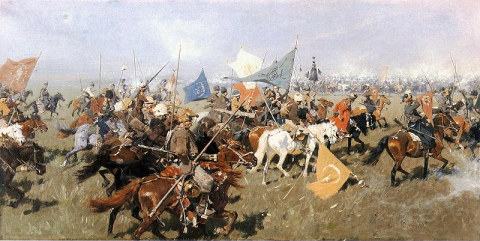
Maroon communities of Americas are of interest to anti-authoritarian left of the area, looking for inspiration outside White/European context. One way to explain history of Cossacks of Ukraine to an American Leftist would be to define it as European analogue of a Maroon society.
The currently popular story of the Ukraine among the mainstream Ukrainian liberal nationalists is that Ukraine is the original Kievan Rus civilized empire, whereas Russia is a cheap copy of it. This story has some consistency issues, but who would like to be the empire anyway, if you may be a freebooter Cossack, roaming freely in wild steppe? And Cossack communities were essentially maroons, deserters of serfdom in Polish-Lithuanian Commonwealth and Muscovy.
There are nuances. Ukrainian nationality was born from various different elements, and Zaporozhian Cossacks are just one of them. But Zaporozhian Cossacks were given an important role in forming the Ukrainian national identity in the 19th century. Also, there are differences between serfdom and slavery – but they have more in common. In the worst periods serfs Muscovy and Russia were sold in markets, tortured for whims of their master and forced to sexual slavery. Plus chattel slavery was only abolished in Russia in 1723, thus some Cossacks were fugitive slaves proper. Obviously the racial aspect was mostly missing, except in case of Roma, who were a racialised enslaved group in Balkans. Some Roma escaped slavery and persecution to Cossack territories of Ukraine and became Cossacks, and were fighting in side of the Bogdan Khmelnitsky uprising of the 17th century.
Some Cossack groups, such as Don and Slobodsky Cossacks eventually aligned with empires for putting down rebellions. But this was also the story of many Maroon communities, for example in Jamaica. These were forced compromises for communities to preserve their autonomy. When studying Maroon and Cossack history, it is important to understand that they were not isolated utopias free from realities and pressures of the outside world.
Cossack social structure is now long gone in both Ukrainian and Russian Cossack regions, but in Ukraine the Cossack history has played a more central role in shaping the current society. Ukraine and Russia have many similarities, and share both history and many of the current ills (leaders with authoritarian tendencies, oligarchs, far-right movements, corruption...), but there are also some important differences. Ukraine has more tendencies of decentralization, freedom and democracy, and much of them come from the Cossack tradition.
Russia has also its own democratic traditions - Veche general assemblies of the city states of the middle ages and Cossack traditions. Kuban Cossacks of Russian south were an offshoot of Zaporozhian and Don Cossacks, and they were sharing much of the culture and even language with Zaporozhia. Unfortunately, these traditions are now heavily suppressed and forgotten, but eventually they will raise again.
Antti Rautiainen

Add new comment