Struggles against the right-wing government in Finland
Submitted by Антти Раутиайнен on 8 October, 2025 - 21:15
Two years of anti-government protests raise questions about organising around collective struggles
This article, edited and published by Freedom, has been adapted from a lecture given at anarchist days, Dresden, 21st September 2024. It has been updated with recent developments. The lecture is available on YouTube and Spotify.
The current government of Finland has been called the most right-wing administration in the country’s political history. It formed in 2023 through a coalition of the centre-right National Coalition Party, the far-right populist party Perussuomalaiset (The Finn’s), the Swedish People’s Party, and the Christian Democrats. The integration of dissenting parties into unorthodox coalitions has been a long tradition in Finnish politics. Under the current government Finland has become a testing ground for the incorporation of anti-immigrant, right-wing populism into national politics.
Since the election, anarchists and radical left organisations formed coalitions around common struggles heightened by the new government. In 2025 anarchists have made attempts to resume the anti-government protests however, but have failed to reach beyond anarchist and radical left circles. The question raised across the two years of organising is, how to struggle together against conditions of economic stagnation and decline?
The context of Finnish politics is an economy hit by several crises at once. Finland’s economy has not recovered since the 2010’s which brought the Eurocrisis and the collapse of Nokia, a company which generated up to 5% of GDP. There is also a continuous decline in traditional exporting industry, made worse by the full-scale war in Russia, and a population aging faster than average. In 2023 the centre-left coalition was defeated by a narrow margin and the neoliberal National Coalition Party quickly found a common language with far-right populists, offering term of ‘you are free to bash migrants as long as we may bash the trade unions.’ The four-party coalition has set up a government program of austerity. This includes budget cuts to every sector except defence, tax cuts for the rich, and various anti-migrant policies to appease the right-wing populists.
Within weeks of the new government forming, two of the biggest anti-government street demonstrations erupted. Nazi jokes made by the Minister of Economic Affairs, Vilhelm Junnila, alongside his speech at a fascist demonstration was reported by the national media. This scandal and the general shock at the inclusion of the far-right populists into the government sparked the ‘Zero Tolerance Against Fascism’ demonstration, attended by 10,000 people on 19 July 2023. In September 15,000 people gathered for the ‘We Won’t Be Silent’ demonstration, demanding the resignation of racists and fascists from the government. Although Junnila resigned, the vague demand of opposing racism was neatly resolved by the government promising to create a position paper on the topic. Already by mid-September 2023, vast majority of the liberal contingent of the anti-racist protest disappeared from the streets and has not been seen since. However, the anti-government movement was far from over.
At the September demonstration anarchists joined with a banner stating ‘If something is to be cut, let’s cut the head of Petteri and Riikka’ referring to the austerity cuts by premier Petteri Orpo and state treasurer, and chairperson of Perussuomalaiset, Riikka Purra. The slogan, originally an adaptation of the UK newspaper Class War cover ‘The Best Cut Of All’ protesting Thatcher’s cuts, provoked media uproar. The backlash successfully sidelined the anti-racists agenda of the demonstration, and protest organisers publicly distanced themselves from the anarchist collectives. No other groups made much effort to introduce wider social issues into the liberal anti-racist mood of the movement.
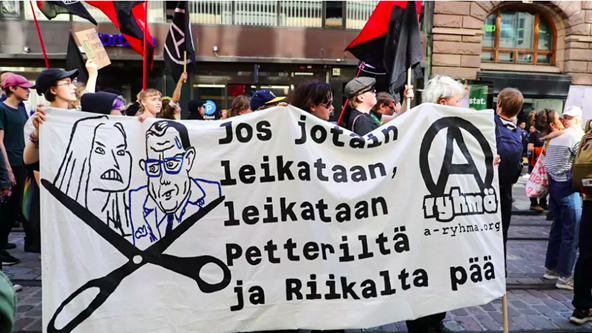
The summer of 2023 also saw a coalition between five Helsinki-based ultra-left groups swiftly created. This included A-ryhmä (a local anarchist groups since 2006), Extinction Rebellion, and three groups inspired by autonomous Marxism. Extinction Rebellion, established a week after the original UK group, brought more activists than the others combined. Together they organised the ‘Hands off!’ demonstration timed to match the government’s budget negotiations on 19 September 2023. The four major demands were to halt budget cuts, defend right to asylum, defend the right to strike, and the protection of biodiversity.
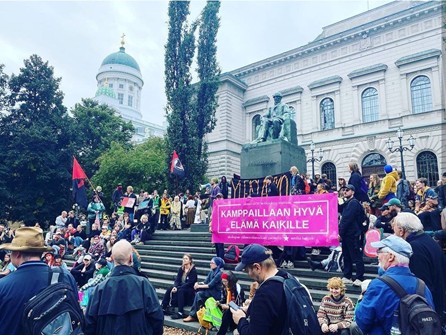
The demonstration drew 600 participants and was considered unsuccessful. The most likely reasons it failed to draw similar sized crowds as the ‘We Won’t Be Silent’ demonstration a week earlier was an inconsistent promise to blockade a government building, to narrow a coalition, horrible weather, and lack of widespread promotion.
It is also representative of the fragmentation of anti-government protest. The day for ‘Hands Off!’ was also the launch date for students occupying Helsinki University’s main building, opposing the cuts to education and student welfare. The movement eventually spread to 16 higher education institutions and 10 high schools/trade schools. They failed to raise demands wider than their immediate self-interest, and the occupation failed to achieve their goals.
Additionally, the Palestinian solidarity movement has been a major focus for anti-government protest. Although the Christian Zionist movement has traditionally been stronger in Finland than support for Palestine, this is no longer the case. In 2023 demonstration against the genocide in Gaza occurred almost weekly and have not dwindled in the two years of the right-wing government. The protests created a government crisis to recognise Palestinian statehood, however under pressure from the Christian Democrats and Perussuomalaiset the prime minister could not pursue it. With so many mobilisations, participants spread thin, unity was elusive. Meanwhile, the government pressed on with its agenda.
One of the biggest challenges to the right-wing government came from the trade unions. In December 2023 the unions launched the direct-action campaign, ‘Painava SYY’ (Serious Cause) which rejected many of the government’s reforms including: cuts to unemployment and benefits, restricting political strikes to one day, and changes to contracts which would limit pay rises and weaken employment security. From the three central unions, SAK, STTK, and Akava, only SAK undertook serious strikes action, organising rolling-one day strikes across industries. This culminated in a one-month port strike between March-April 2024. This was expected to halt foreign trade and result in serious disruption, however there no major industry shutdowns. Due to decreasing opinion polls in support of strike action, or the lack of willingness to really rock the boat, SKA ended the campaign before imposing a general strike and won slightly less strict changes to employee’s contracts.
As the unions chickened out, anarchists continued to call for a general strike. The ‘Hands-Off!’ coalition organised an event to discuss the history of a general strike in Finland and gathered 400 people in a general strike bloc at the Mayday marches of the unions and left-wing parties. This reached further than the usual anarchist circles, but failed to instigate a general strike.
Throughout 2023-2024, ultra-left coalitions remained active in anti-government and anti-fascist organising. A coalition between A-ryhmä, anti-fascist Varis network, and Left Youth created in 2016, continued its annual counter demonstration against the far right ‘612’ march on 6 December 2023. The march was created by Nazi organisation Nordic Resistance Movement and other Finnish far-right groups. In 2023 right-wing populists deserted the march, leaving it for fascists alone. For several hours, 1,500 counter-protestors occupied the square, delaying the march, and demoralising the fascists. In 2024, right-wing populist MP Teemu Keskisarja attended the march, however, despite the backing from parliament, fascist numbers were again decreasing.
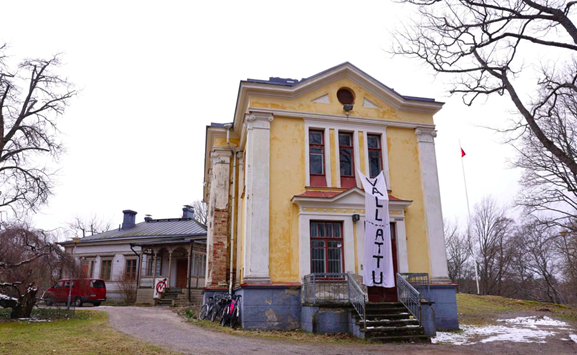
Also in 2024, the fascist ‘Blue-Black Movement’ party attempted to organise reading circles in public libraries, using a legal loophole designating libraries as free public spaces for any groups use. In Helsinki, reading circles were organised and the library administration was first adamant to permit the fascist gatherings. Due to loud anti-fascist protests inside the library, the library reconsidered the interpretation of law and the fascist gatherings were pushed out from public libraries nationwide. Additionally, in April, the ‘Hands Off!’ coalition organised the ‘Unruly Street Party’ where 400 people gathered and was continued with a squatting in a former manor house close to government officials’ residences. The house was evicted after 7 weeks; however, another former manor house was occupied further from the centre of the city, and remained occupied until December.
Active demonstrations and protests against the right-wing government diminished through 2024. The trade unions rounded up their direct-action campaign and the ‘Hands Off!’ coalition collapsed as Extinction rebellion moved forwards with a campaign to propose more ‘environmentally friendly’ cuts. The Left party won the EU parliament elections of June 2024, gaining 17% of the vote. After this, most leftists seem to be happy to wait for the next parliamentary elections.
In April 2025 anarchists resumed anti-government protests by forming a queue for bread to the prime minister’s residence in Helsinki. The protest failed to reach beyond the anarchist and radical left circles with around 300 demonstrators attending the event. Despite two years of efforts from anarchists and the radical left to form coalitions around common struggles, it is clear that different organisations and groups pursued their own agenda without attempting to unite on common struggles.
Despite this, there are positives from the anarchist, anti-fascists coalitions, and wider anti-government protests of 2023-2024. Fascists were successfully marginalised and pushed out of public libraries, unions showed their strength and gained minor concessions, and Palestine solidarity showed endurance and provoked a government crisis.
Yet, some big questions remain as the Finnish economy stagnates and the right-wing coalition remains in power. In 2024, the Finnish economy was the worst in Europe, and currently the unemployment rate of 9.9% is behind only Spain. How can growing number of unemployed people be organised? How can anarchists intervene in trade union struggles when they are hostile to outside intervention? How to united anti-racist and social struggles, and stop the fragmentation of struggles?
Antti Rautiainen